I think that it's also literally all plant-based meat replacers (meaning products intended to mimic meat, rather than just replacing meat with plants).
I agree, it is used in place of meat, but I think that it is not usually intended to mimic meat. For example, I think that few people would claim you could use tofu as a drop-in recipe replacement without affecting flavor, whereas meat replacers like Impossible are intended to be able to do exactly that.
In case you missed the intentional misspelling, rather than are just going along with the joke: the word used was 'udder' (a cow's teats) rather than 'utter'.
> Every time I've tried to use it (as recently as half a year ago) it's still a shitshow and never displays or updates apps correctly. Half the time an app showed up on the website that didn't show up on the phone app.
Sounds like an accurate recreation of the Play Store experience to me.
This is not me simping for Google, I would honestly prefer literally anyone else with an acceptable app store experience, but I can honestly say I've never had that experience with the Play Store. If there's an update, it updates. If there's an app, it appears in search. On the rare occasion an app doesn't appear and I go to the Play Store website looking for it, the reason the app didn't show up is because it's listed as incompatible with my device (usually Android version too low or too high).
I believe that, (possibly only) in the early days, it offered to add any imported music to your library, which I think it indeed did by converting to AAC and putting in a directory structure of its choosing.
It probably could convert to AAC, but the biggest issue for collector nerds with carefully curated collections of mp3's organized in folders by artist and album and with perfect metadata was that iTunes would take all your hard work, shake it around, rename all the files and dump them in a single folder and fuck up your metadata. At least that's how I remember it, but it's over 20 years ago ...
I think the core lesson of the story is knowing if your hobby is listening to music or curating a music collection. Optimize for one or the other.
I went from meticulously curated MP3 collection on Linux to letting iTunes do it for me, and I realized that the meticulous curation and hunting down album art and everything was a hobby I didn't actually love. But if you do love it, great! Different tools for different jobs.
Submitting to iTunes made syncing to the phone much easier, but I've been using claude to rebuild/repair my 20+ year old library, and have learned that iTunes has very weak if any support for "work" - a feature it has to split up classical music the way the CD does (once file per movement). Frustrating that there will likely never be a high-quality syncing player that works well with iPhones.
I remember the trick was to use a network hard disk or drive for the music. iTunes kept the organized folders and all files untouched while building its metadata-only archive in local. But in general, yes, the tendency to mess with your file was built-in.
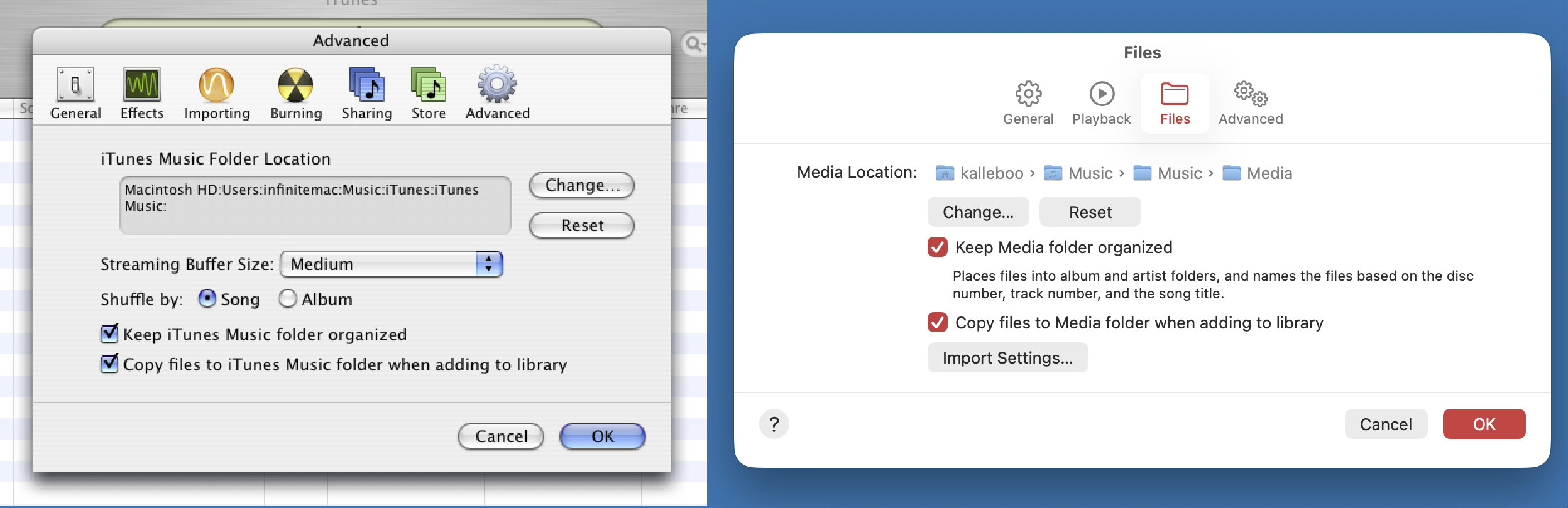
The trick was to skip the onboarding and go into the Preferences, there was an option there to disable putting your files in the music library folder and messing with the layout
edit: I just compared iTunes 4 and Music in Tahoe and they still have the same preference! It's funny how they clearly did a s/iTunes/Music/, resulting in the "Music/Music" dir https://kalleboo.com/linked/itunes4-vs-musictahoe.png
As I recall it, the AAC option was for syncing to iPods with lower capacity (like the Shuffle) so that it would convert your 320/256kbps MP3s to 128kbps AACs to fit more music. It did this for a copy of them though, I've never heard of it actually converting your main library and checking out an old version of iTunes it has no way of converting your whole library (just individual tracks one by one).
Having iTunes organize your music into its own folder structure was an preference you could turn off, but that option was not shown in the onboarding so it ruined many a people's meticulously organized files...
Presumably there's not much logical obstruction to all human-understandable math eventually being formalized, although the willingness and ability to commit the requisite enormous amount of time will probably be insurmountable. But definitely that hasn't happened already!
Do you think "Race Inspired Cosmetic Enhancements" is the origin of "ricing" / "riced-out" or a backronym[1]?
Honest curiosity about language and language use.
In fairness and full disclosure: I have believed until now that the language comes from rice-burners and related, and I have never liked it. If I were still in communities that used it (unix desktop crowd), I might proactively steer newcomers towards your acronym as a kind of reclaiming.
> I might proactively steer newcomers towards your acronym as a kind of reclaiming.
Any negative connotations "rice burner" once had was lost when the term shifted towards referring to cars instead of humans. But now re-recognizing that the enhancements are inspired by the East Asian race turns the connotations back to humans. Isn't that a regression?
Yes, the term originated as derogatory slang towards the Asian population in the early 1900s, and its use towards them became especially popular during the Korean War. There is no question there. However, as before, the term evolved away from people and towards cars. You cannot be derogatory towards an inanimate object. It doesn't have a mechanism to internalize feedback. In that evolution, the term lost its derogatory connotations. The historical usage, while a part of our past, is used no more.
Reintroducing this to be something about a population's race reinstates the derogatoriness. You can be derogatory towards humans. Minimizing the cosmetic enhancements to be being inspired by the East Asian race and not valuable human achievement brings us right back to the same place we were when Japanese cars started being introduced into the North American market, diminishing the human contribution. It is a regression.
For what it's worth, it's not a problem with multiple kinds of multiplication (multiplication by a scalar can be viewed as multiplication by a specific kind of matrix), but with the idea that one can cancel in a multiplication. Since you can't cancel in matrix multiplication, you run into unexpected trouble when you try to do so, even if that's the only multiplication in sight. (In fact, you can't cancel in scalar multiplication either unless you've checked that you aren't multiplying by 0 …. Also, I'll note that surely no young mathematician has encountered the P = NP problem without thinking for a sophomoric moment that the solution is N = 1.)
P = NP is actually one of the worst abuses of symbology I've seen in math.
"""During his own Google interview, Jeff Dean was asked the implications if P=NP were true. He said "P = 0 or N = 1." Then, before the interviewer had even finished laughing, Jeff examined Google's public certificate and wrote the private key on the whiteboard."""
I'd call P = NP computer science rather than math, but perhaps it's reasonable to call it sufficiently on the theoretical side of CS that it really is math.
Which part is a sin? Using LLMs to deal with a lack of English-language fluency? I am a scientist (actually a mathematician, if it matters), and, if that's the way to deal with the practical hegemony of English in the scientific literature, then I have no problem with it. Rather that than people with important ideas can't get them before the scientific community. As long as the authors personally check and stand behind the scientific content of their papers, what do I care how the exposition was produced, especially if the role of LLMs is properly disclosed?
It seems to me like we're saying the same thing. I'm saying that there is a practical bias, as in, it's there in the real world whether we like it or not, that can prevent some papers from appearing just because of limitations on English-language fluency, not because of any lack of scientific content. One solution is to get rid of it, but that's a long-term project. If we have an immediate remedy that works, if the authors still take responsibility for the scientific content, and if the use of the tool that provides that remedy is responsibly disclosed, then it seems like a win all around, except perhaps that it makes the need for the longer-term solution less obvious.
It would be nice if scientists could write and publish in their first language. If a machine translation brings it to a wider audience fine, but the lack of disclosure of who authored the paper is a problem.
I'd way rather read a translation in which the author themselves has played a part, and at least nominally signed off on it, than one done on the fly with even less than usual guarantee of its correctness.
(I agree that authors should be able to publish in their first language, but I also note that the historical practicality has been that publication in non-dominant languages has resulted more in silos than in broadening access.)
Depending on your mathematical background, it may be easier to get a grasp on Tannaka duality, of which I assume, but don't know, this may usefully be viewed as a (possibly too) vast generalization.


There, fixed that for you.
I think that it's also literally all plant-based meat replacers (meaning products intended to mimic meat, rather than just replacing meat with plants).
reply