Porting to DOS sounds like a great plan for retro games, to only have to do the port once and know there are stable emulators to run it in, as opposed to porting to some modern OS and then have to port the game again and again to keep up with API changes.
I'm assuming they mean SDL ports of DOS games. SDL is actually one of the most stable libraries that a native game can use. They make breaking changes to the API once every 10-15 years, and they write a compatibility layer that implements the previous version's API using the current version's API as a backend. This has happened twice so far, so there's an SDL 1.2 implementation that uses SDL 2 and an SDL 2 implementation that uses SDL 3. These can be chained together, so for example you can run an SDL 1.2 game from the early 2000s on a modern Linux system and it'll have native Wayland and Pipewire support thanks to using SDL 3 behind the scenes.
If you use Kagi Assistant, you can pick one of your lenses (i.e. lists of domains to restrict searches to) in chats. Not sure if their API has that as well or some other way to restrict searches. Also not sure if the Assistant (or API) respects blocked domains when searching.
Over water, probably something like the entire 60th parallel south.
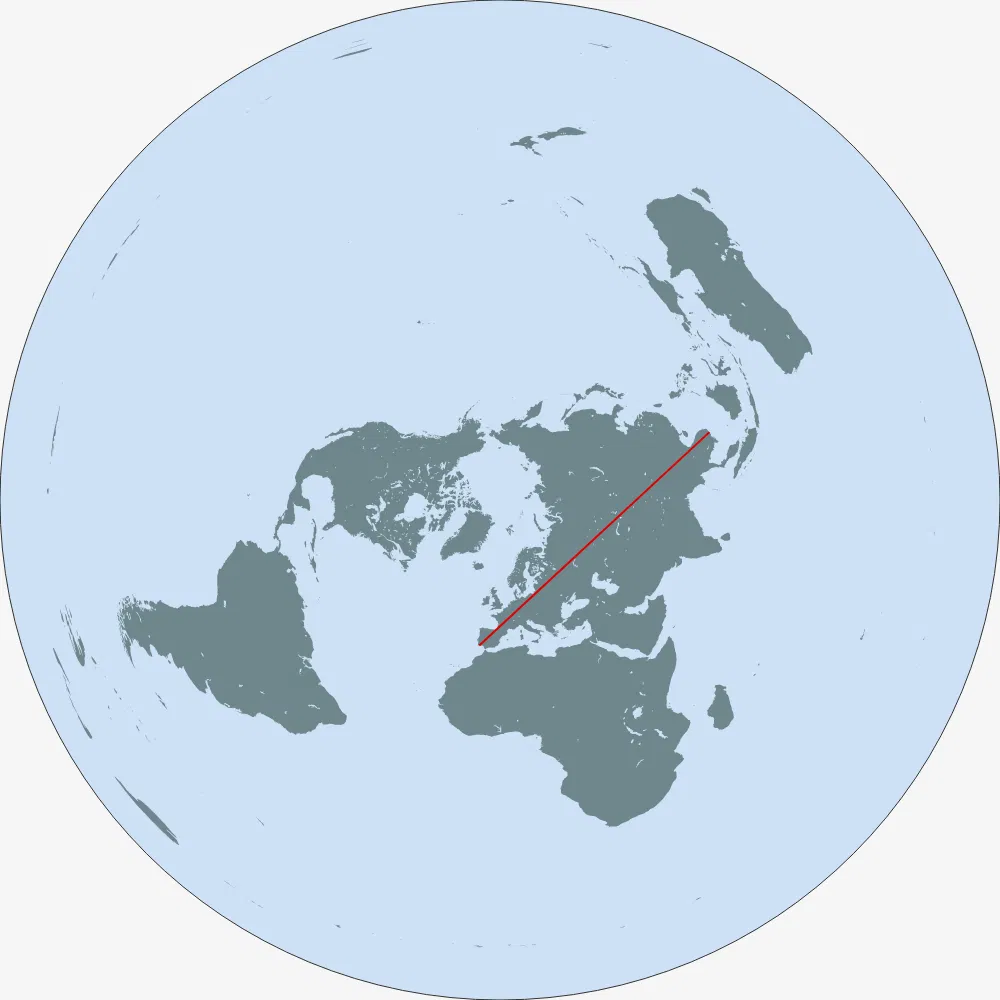
Over land, I think you want to start near the westernmost point of the African continent and thread the needle of the Isthmus of Suez, and stay south of the Caspian Sea. At least in the projection gcmap.com uses (plate carree - essentially the x-coordinate and y-coordinate are just raw longitude and latitude), this keeps you south of Lake Baikal and allows you to get very far east in far eastern Russia. Something like 17.5 N, 16 W to 69 N, 178.5 E seems to work:
This is different from the Portugal-to-China path that is the longest over land in reality, which a flat-earther would have crossing the Mediterranean.
Yeah, but how do they explain, that the same world looks different, e.g. having different distances and angles depending on the map "type"? This is kind of important for traveling, navigating or measuring the size of the property you own.
They’re flat earthers, they either have no explanation or a completely bogus explanation. Certainly don’t look for any semblance of reason. They just invent whatever to try and feel like they have some secret knowledge.
I'm just curious. I think they still believe to have a consistent worldview themself, as every human does. My question was more regarding their self-understanding and less the kind-of "marketing" they throw at outsiders.
They would tell us we are contradicting ourselves because none of them are straight lines in the traditional sense, if we really believe the Earth is a sphere. Don't underestimate trolls ;-)
I think it is the exact opposite. Keep remakes running in DOS instead, and they will run everywhere that DOSBox runs, which is pretty much everywhere, and also everywhere that you can boot up FreeDOS (including in QEMU), plus in other emulators, almost guaranteeing that the executable will keep working somewhere for a very, very long time. Versus a port to some modern system that will then require constant updates and ports forever to keep it running, and as soon as no one is around to maintain the project it will be a pain to get it to run anywhere.
It is always good to see open source reimplementations of old games, but sad to see almost none of them keep MS-DOS support. It's easily the most portable and future-safe of all virtual machines you can run games in.
I see merit in both approaches. The emulation approach preserves the original experience, which is valuable when you want to experience the work in its original form. This is great for scratching the nostalgia itch, as well as anyone who wants to study the original work. The porting approach transforms the original work into a form that is approachable to the modern game player. This is great for people who want to play a game but are not as concerned with a "vanilla" or the as-it-was-released experience. This could mean the port surfaces new controls (touch controls for phone/tablet devices), or applies quality of life changes to patch out frustrations.
Almost 30 years ago when I wanted to backup my synth, its complete MIDI spec was in the printed user manual. Saving all sysex was just a matter of writing a short C program to send a few bytes to the ALSA MIDI device and then read the response back and save to disk.
No longer own that synth, but I still have my backups. No reason to believe the raw files would not still work. No dependency on any special software.
PC was a clear winner for RPGs, adventure games, and wargames/strategy, even in the early days of PC/XT. Anything that could make use of more RAM and disk, while also not demanding too much of graphics or audio, was great on PC.
Even as someone that grew up with GW-BASIC and had moved on to Turbo Pascal by the time qbasic came out, I must say you have a point. I think however that the more traditional BASIC "IDE" with line numbers etc, used in GW-BASIC, has its charm and is still fun to play with. It's quite unlike any modern IDE, but there is some logic to it and with some practice it isn't bad for what it needed to do.
Oh definitely! Some of my earliest memories were my dad helping me type in basic programs that were listed in the popular COMPUTE! magazine back in the day.
  10 PRINT "YOU'RE DEFINITELY GOING TO GET FATIGUED"
  20 PRINT "AFTER A FEW HUNDRED LINES OF TYPING THIS"
  30 PRINT "IN AND MAKE A MISTAKE. HAVE FUN!"
  40 PRINT CHR$(7)
There are some binary releases there from 2022, but I did not try those. The binary I built from source has worked very well.
Never tried to build the DOS source, but I really enjoyed playing with the toolchain they included with the MS-DOS 4 source code release. It's pretty much a complete, MIT-licensed (but binary only) Microsoft toolchain (msc, masm, make, link, etc) from ~1988. For some of my recent hobby projects I put that toolchain in my git repos, to have everything self-contained, with DOSBox as a virtual machine both for building and running, and no other dependencies. So I am happy Microsoft released the DOS code, even if I did not look much at the code itself.
Sounds like pcbasic, that implements GW-BASIC in python, both with a SDL GUI and a TUI, and it contains a partial PC emulator to make it possible to peek and poke some addresses and such. Impressive project, well documented and seems stable and nothing obvious is missing.


reply